/ recent work / castle-bedroom-doors
The Castle of a Thousand Bedroom Doors
A bawdy fantasy comedy text adventure built in the Defy Destiny TEXT engine, with typed commands, six romantic worlds, voice, music, saves, Fate Rewinds, and five endings.
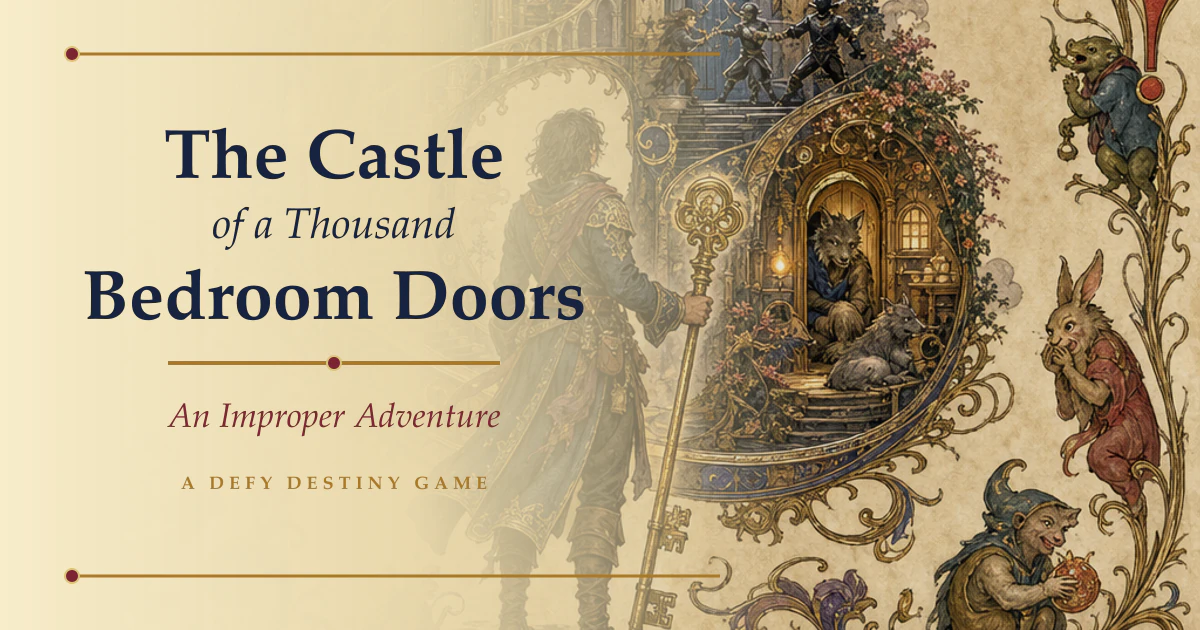
The Castle of a Thousand Bedroom Doors is a full-length fantasy comedy text adventure about a castle that treats romantic destiny like inventory management. It has standards. Most of them are appalling.
Players type what they want to do. The game parses the command, responds in authored prose, remembers what happened, and lets consequences travel between six very different romantic fantasy worlds. The illustrations set the scene. They do not become hotspots, because this is interactive fiction rather than a scavenger hunt for the one clickable candlestick.
The problem
Classic parser adventures make imagination do the rendering. That is still the good part. The less charming part is the brittle command line, the silent room, and the sensation that the parser is waiting to correct your grammar.
We wanted the freedom of a Zork-style text adventure with the pace and finish expected from a modern browser game. That meant typed commands, generous vocabulary, meaningful state, quick feedback, designed typography, music, selective voice, and just enough visual theatre to make a sentence land harder.
The game
The protagonist arrives at an enchanted castle with a vacancy, a suspiciously intimate bureaucracy, and no useful recollection of applying. Someone has taken the Master Key. Recovering it means crossing six bedroom suites built from unruly fantasy-romance premises, then deciding whether the Castle should be liberated, reformed, inherited, escaped, or catastrophically encouraged.
- Six authored suite worlds plus the Castle hub and Master Bedroom finale
- A six-to-eight-hour first-playthrough target with branching routes and five endings
- Typed verbs, object aliases, conversational commands, contextual hints, and deliberately silly refusals
- Character and romance settings that alter pronouns, address, attraction, and relationship outcomes
- Named saves, rolling autosave, quicksave, JSON export and import, and three limited Fate Rewinds
- Thirteen music cues, thirty-two sound effects, and 175 mastered Spotlight Voice lines with captions
Text is the interface
Every meaningful action stays in the parser. TAKE ROPE, ASK VESPERA ABOUT THE CONTRACT, KISS THE WEREWOLF, and less printable experiments all travel through the same command surface.
Art appears at major thresholds to establish a suite, character group, or tonal turn. Inventory remains readable text with restrained iconography. Motion is reserved for authored moments: ink settling into a new line, a word reacting to the scene, or the interface briefly behaving as though the Castle has opinions about being observed.
The restraint matters. If every noun wriggles, none of them are funny.
A reusable TEXT engine
The Castle also served as the production game for Defy Destiny’s TEXT format. The engine and Studio builder had to support more than one manuscript wearing a custom component.
The authoring model separates rooms, interactions, puzzles, exits, checkpoints, voice cues, sound cues, Living Word effects, inventory, endings, and campaign state. Studio exposes those systems as editable ledgers and suite projects, while the runtime consumes stable IDs and validated manifests.
That gives future parser games the useful machinery without inheriting this Castle’s particular fixation on contracts, etiquette bats, and whether a barbarian can plate breakfast seductively.
Audio that knows when to move aside
The score begins with an authored theme during intake, then moves into area-specific loops. Music ducks beneath narration, voice, and important effects. Mute is always available, captions cover spoken lines and meaningful sounds, and reduced-data settings avoid unnecessary media loads.
Spotlight Voice gives major reveals and character turns a performed line without turning every parser response into an invoice. Stable cue IDs keep the same content ready for broader dialogue coverage later.
Accessibility and control
The complete game works from the keyboard. Focus remains visible, command history is navigable, save dialogs are labelled, captions do not depend on audio, and reduced-motion mode turns animated prose into immediate static text.
The decorative plates never contain controls. There is no point-and-click route hiding beside the parser, and no gendered protagonist portrait deciding what the player looks like before they finish the intake form.
Recent shipping
- 2026-08-04 · Shipped the Castle campaign, Defy Destiny TEXT runtime, Studio builder, saves, Fate Rewinds, complete audio system, suite art, and five-ending finale.
- 2026-08-04 · Verified 35 browser journeys, 293 Castle tests, 41 IF-engine tests, 32 Studio and catalogue tests, and a clean production build.
Questions people ask
Is The Castle of a Thousand Bedroom Doors a choose-your-own-adventure?
It is interactive fiction driven by typed commands rather than a list of choices. The parser accepts verbs, objects, aliases, conversation topics, inventory actions, and contextual solutions.
How long is the game?
The first-playthrough target is six to eight hours. Branches, relationship routes, optional interactions, Fate Rewinds, and five endings give later runs different shapes.
Can I save my progress?
Yes. The browser game includes autosave, named saves, quicksave, import and export, and three limited Fate Rewinds for stepping back from a regrettable decision.
Is it a point-and-click game?
No. Images establish atmosphere, but every interaction is text based. Players type commands such as TAKE THE ROPE, OPEN THE DOOR, or ASK ABOUT THE KEY.
Play it
Play The Castle of a Thousand Bedroom Doors, or open the full game page at games.threesided.com for artwork, features, platform notes, and release history.